
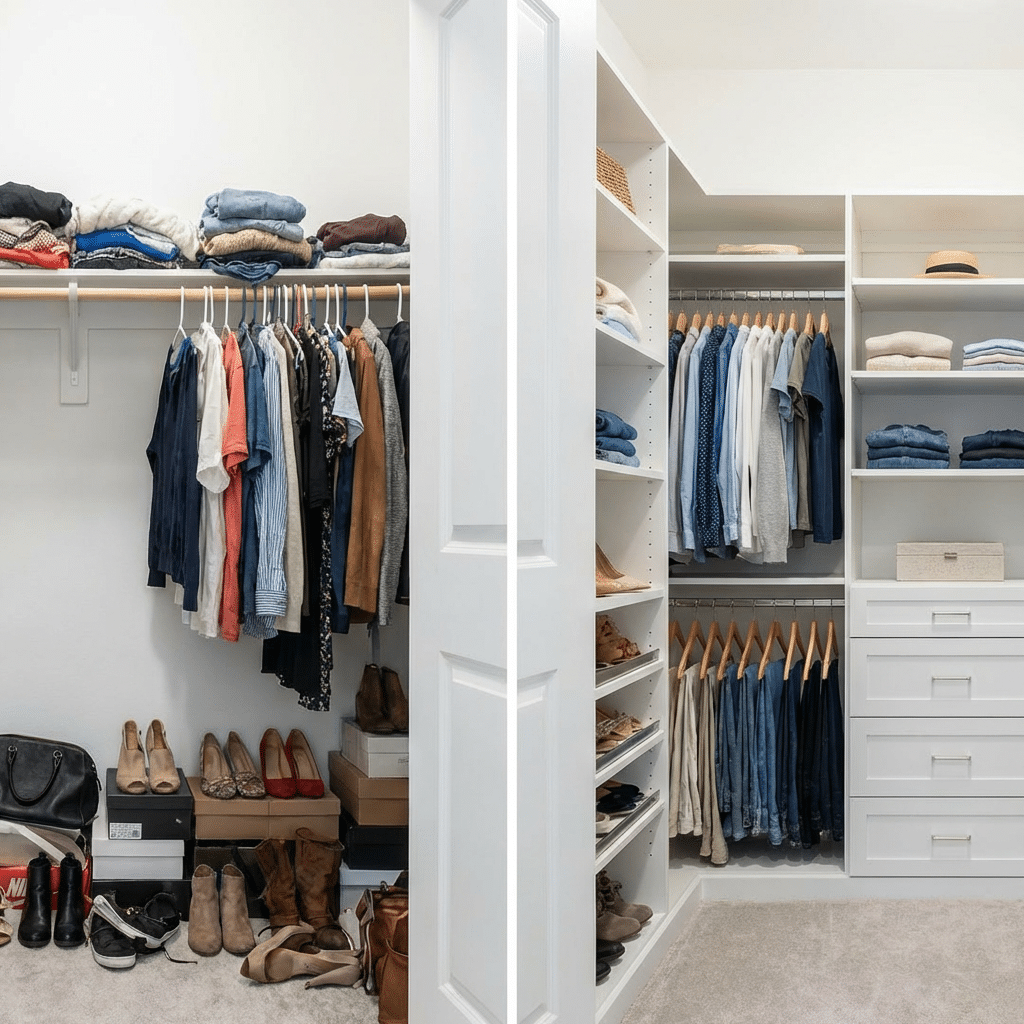
You open your closet door and face the same problem every morning. Clothes crammed together on hanging rods. Shoes piled on the floor. Accessories tangled in a drawer. You know there should be enough space, but somehow there never is.
Most closets in New Albany homes waste 40 to 50 percent of their available space. This happens not because the closet is too small, but because of common closet design mistakes made during construction or previous renovations. These design mistakes to avoid include poor layouts, inadequate storage solutions, and choosing poor-quality materials that don’t stand the test of time.
Many of these common closet problems have straightforward solutions. Some require simple add-ons you can install yourself. Others need professional closet design help to maximize every inch of available space. Here’s how to identify what’s stealing your closet space and practical tips for fixing these mistakes.
Single Rod Layouts: The Biggest Space Waster
Walk into most builder-grade closets and you’ll find one hanging rod mounted about five feet high with a shelf above it. This represents one of the most common closet design mistakes that waste valuable vertical space in both walk-in closets and reach-in configurations.
Think about your wardrobe. Shirts, folded pants, skirts, and jackets rarely need more than three feet of hanging space. When you hang everything on a single rod at five feet, you create two to three feet of unused space below while leaving upper storage potential completely wasted.
The problem becomes even worse in a walk-in closet where you have multiple walls to work with. A single rod layout in a master closet means you’re using perhaps 30 percent of your available hanging space. The rest becomes clutter zones where items pile up because they have nowhere else to go.
The fix: Install double hanging sections with rods and shelves positioned at strategic heights. Mount one hanging rod at about 80 inches for full-length items like dresses and coats. Add a second hanging rod at 40 inches for shirts and pants. This simple change doubles your hanging capacity immediately.
For reach-in closets, you can buy adjustable double-hang systems at hardware stores. Walk-in closets benefit more from custom closet design that creates a mix of storage types including hanging sections, shelving, and drawers positioned exactly where you need them.
Poor Shelf Height Choices That Create Dead Zones
Fixed shelving installed at arbitrary heights creates two problems that waste closet space. Shelves placed too close together waste space when you store small items. Shelves spaced too far apart leave gaps above folded clothes and bins where nothing fits.
Most closets have shelves every 12 to 16 inches. This spacing works for some items but fails for others. A sweater needs 10 to 12 inches of vertical space. Shoe boxes need 7 to 8 inches. Purses and bags need 14 to 16 inches. When shelf heights don’t match what you actually store, you end up with wasted space on top of items and shelves that feel impossible to find what you need.
The fix: Replace fixed shelving with adjustable shelving systems that let you customize spacing based on your wardrobe. Track-mounted shelves adapt as your storage needs change over time. This flexibility eliminates dead zones and helps your closet feel more organized.
Professional closet designers often recommend creating zones within your closet. Dedicate one section with closely spaced shelves for shoes. Another area gets wider spacing for bulky items. A third zone combines shelves and hanging space for folded clothes and hanging clothes in the same area.
The 12-Inch Rule Most Homeowners Ignore
Here’s a measurement guideline that professional designers use: Leave 12 inches between shelves for folded clothes, 7 inches for shoes, and 16 inches for bulkier items like handbags. Measure your items before installing closet shelving. This prevents the common mistake of guessing and getting it wrong.
When planning your closet layout, also consider how items hang over the edge of shelves. Folded sweaters typically measure 10 to 11 inches tall when stacked. If you place a shelf 12 inches above them, you have just one inch of clearance. That works, but 14 inches gives you room to easily grab items without disturbing the entire stack.
Ignoring Vertical Storage Potential
Look up in your closet right now. See that empty space between the top shelf and ceiling? That’s wasted storage space. Now look down. Is your floor cluttered because you have nowhere to put shoes and bags?
Most people use only the middle section of their closets. The upper 18 to 24 inches and lower 12 inches go unused or become dumping grounds for items without designated spots. This represents a critical closet design error that’s easy to fix but hard to spot until a closet designer points it out.
In New Albany homes built before 1990, you’ll often find eight-foot ceilings. Newer construction typically features nine-foot ceilings. Either way, you have usable vertical space you’re probably ignoring. A well-designed closet uses every inch from floor to ceiling.
The fix: Install floor-to-ceiling cabinetry and storage systems. Add high shelves for seasonal items and luggage. Use the floor space with built-in shoe racks, drawer units, or pull-out baskets that keep items organized and accessible.
Wall-mounted hooks and specialty organizers also capture vertical space efficiently. Mount hooks on side walls for bags, belts, and scarves. Use over-the-door organizers for accessories and small items. These solutions work particularly well in a small closet where every inch counts.
Consider installing a valet rod that pulls out when needed. This gives you temporary hanging space for tomorrow’s outfit or items fresh from the dry cleaner. When not in use, it tucks away against the wall, taking up minimal space.
Poor Layout Planning That Creates Awkward Access
Bifold doors seem practical until you realize they block access to the sides of your closet when open. Sliding doors create the same problem by hiding half your closet at any given time. Even standard hinged doors require floor space to swing open, which becomes problematic in tight bedrooms.
Beyond doors, the internal layout of many closets makes them hard to access and frustrating to use. Long hanging sections without breaks force you to push through clothes to find what you need. Deep shelves at the back wall become black holes where items disappear. Corner spaces in walk-in closets turn into dead zones because nothing fits properly.
The fix: If you’re stuck with bifold or sliding doors, organize your closet so frequently used items sit in the accessible center section. Place seasonal or rarely used items in the harder-to-reach areas. This simple closet organization strategy makes daily use more efficient.
For a more permanent solution, consider replacing problematic doors. Pocket doors slide into the wall and provide full access without requiring swing space. This works particularly well when designing a custom closet where you can plan the entire space from scratch.
Interior layout improvements make an even bigger difference. Install pull-out rods or baskets in deep sections so you can access items at the back. Add corner cabinet units or rotating fixtures that make awkward angles functional. Break up long hanging sections with a mix of storage types so you can see everything at a glance.
A professional closet designer can help you plan your closet layout to eliminate access problems. They assess your specific space, including any architectural quirks, and design around them rather than fighting against them.
Inadequate Lighting That Hides Your Storage
Dark closets hide your storage potential. When you can’t see what you have, you buy duplicates. When you can’t see into corners and upper shelves, those areas go unused. Poor lighting represents one of the most overlooked design mistakes in closet planning.
Most closets rely on ambient light from the bedroom or a single overhead bulb. This creates shadows and makes it hard to find specific items, especially in a walk-in closet with deep shelving and multiple zones. You end up pawing through hanging clothes trying to distinguish navy from black, or searching through a drawer because you can’t see what’s inside.
The fix: Add LED strip lighting under shelves and along hanging rods. These fixtures cost $15 to $40 per strip and plug into standard outlets. Motion-activated options turn on automatically when you enter, adding convenience without increasing energy costs.
For walk-in closets, consider adding recessed lighting or a pendant fixture as a focal point. Proper lighting transforms how you use the space and reveals storage opportunities you couldn’t see before. It also makes your closet feel like an extension of your bedroom rather than a dark storage cave.
Position lights to eliminate shadows. Place LED strips at the front edge of shelves so light shines down on contents. Mount lights above hanging rods so you can see clothing colors accurately. Add lighting inside cabinets and drawers for complete visibility.
Choosing Poor-Quality Materials and Hardware
Not all closet systems are built the same. Wire shelving sags under weight and creates marks on folded clothes. Particle board shelves deteriorate over time, especially in humid conditions. Cheap hanging rods bend when loaded with winter coats. Drawer slides stick after a few months of use.
Choosing poor-quality materials to save money upfront often costs more in the long run. You end up replacing failed components, dealing with sagging shelves, or living with a closet that doesn’t work properly. This mistake affects both DIY installations and some professional closet companies that cut corners on materials.
The fix: Invest in durable materials that will stand the test of time. Solid wood or laminate shelving supports more weight than wire or particle board. Quality hardware includes soft-close drawer slides and heavy-duty hanging rods rated for substantial weight.
When evaluating custom closet options, ask about materials and construction methods. Quality cabinetry uses solid wood or high-grade laminate with reinforced joints. Hanging rods should be metal, not plastic. Drawer boxes should have dovetail joints and quality slides.
A professional designer can help you understand material options and their longevity. They’ll explain the difference between entry-level and premium choices so you can make informed decisions based on your budget and how long you plan to stay in your home.
Missing the Mix: Single-Purpose Storage Design
Many closets fail because they’re designed for only one type of storage. All hanging space with no shelves. All shelves with nowhere to hang clothes. No drawers for small items. No baskets for accessories. This single-purpose approach wastes space because different items need different storage solutions.
Your wardrobe includes hanging clothes, folded clothes, shoes, accessories, bags, and seasonal items. Each category needs its own designated space. When you try to make everything fit into hanging sections or pile everything on shelves, you create clutter and waste the closet’s potential.
The fix: Design your closet with a mix of storage types. Combine hanging sections with shelves at various heights. Add drawers for undergarments, accessories, and small items. Include basket storage for items that don’t fold or hang neatly. Create specialized zones for shoes, bags, and seasonal items.
This approach lets you store each item in the most efficient way. Hanging clothes get hanging space. Folded sweaters get shelves. Shoes get angled shelves or cubbies. Belts and scarves get hooks or specialized organizers. Everything has a designated spot, which makes it easier to find what you need and put things away.
When planning a new closet or evaluating your current setup, inventory what you actually own. Count your hanging items, folded items, shoes, and accessories. This data helps you determine the right mix of storage types for your specific wardrobe.
When Simple Fixes Aren’t Enough: Signs You Need Professional Help
Sometimes the problems run deeper than a single rod or poor lighting. You might need a professional closet designer if you’re experiencing these common closet problems:
Your closet has awkward angles, sloped ceilings, or architectural features that waste space. You’ve tried organizing solutions but still can’t fit your belongings. Your storage needs have changed significantly over time. You want to maximize every inch of a small closet. Your current system feels permanently cluttered despite regular organizing efforts.
Professional closet designers assess your specific storage needs, measure your space precisely, and create custom closet solutions that address multiple problems simultaneously. They spot wasted space you might miss and design around obstacles like windows, electrical outlets, and structural elements.
Custom closet design offers features that off-the-shelf solutions can’t match. Pull-out accessories make deep spaces accessible. Specialized storage accommodates specific items. Configurations tailored to your exact ceiling height and wall dimensions eliminate all wasted space. Quality cabinetry and hardware ensure your investment lasts for years.
A closet designer can help you understand what’s possible in your space. They’ll show you how to transform a cramped, inefficient closet into an organized storage system that makes your daily routine easier. For New Albany homeowners, this expertise makes particular sense in older homes where closets were built smaller or in newer homes where you want to maximize builder-grade spaces.
Common Mistakes Have Clear Solutions
These closet design mistakes waste space in most homes: single rod layouts that ignore vertical potential, poor shelf heights that create dead zones, inadequate lighting that hides storage, awkward layouts that make access difficult, choosing poor-quality materials that fail over time, and single-purpose designs that don’t match how you actually use the space.
Each problem has solutions ranging from simple DIY fixes to professional custom closet systems. Start by identifying which mistakes affect your closet. Try basic improvements like adding a second hanging rod or installing better lighting. These changes cost little and deliver immediate results.
If basic fixes don’t solve your storage problems, or if you want a comprehensive solution that addresses multiple issues at once, professional assessment reveals your closet’s full potential. A well-designed closet should feel like an extension of your bedroom, not a source of daily frustration.
Ready to Fix Your Closet Design Mistakes?
WindowDecor has helped New Albany homeowners transform cluttered, inefficient closets into organized, functional spaces for over 30 years. Our team provides free design consultations to assess your specific storage challenges and create custom closet solutions that work for your space, lifestyle, and budget.
We design and build custom bedroom closets, garage storage systems, pantry organization, and specialized closet solutions for any room in your home. Our professional installation ensures quality cabinetry and hardware that will serve you for years to come.
Call (502) 713-3535 to discuss your closet project. Let’s turn your wasted closet space into the organized storage system you deserve.
