
This post answers the window treatment FAQs homeowners are afraid to ask out loud. From budget fears and out-of-square frames to what happens if you hate the first design plan, here are honest answers to the most common questions we hear. No pressure, no sales pitch, just straight talk from a Louisville-area team with over 30 years of experience.
The Questions Louisville Homeowners Are Afraid to Ask
Choosing new window treatments for your home should feel exciting. For many Louisville, KY, homeowners, it feels more like a trap.
You’re not sure what things cost. You don’t know which covering works best for each room. You’ve already bought blinds from a big-box store, and you wonder if that was a mistake. You’re unsure how to choose the best products for your budget. And you definitely don’t want to sit through a high-pressure sales pitch just to get answers to common questions.
These are real concerns, and many people share them. Most consider how much work is involved and quietly put the decision off for another year. There is no judgment here. We hear them every week during free consultations. So we put the most common window covering questions right here, with honest answers to common questions about cost, fit, and style, and no spin.
This is your guide to choosing the right window treatments with confidence, so you can make informed decisions before you ever pick up the phone. Many window treatments are available at different price points, and knowing your options makes the whole process easier.
Why This Feels So Complicated
Walk into any showroom or search online, and you’ll find hundreds of types of window treatments. Blinds or shades? Shutters or drapery? Roller shades or cellular shades? Shades or blinds for the bedroom? Curtains or shutters for the living room? Most people struggle with choosing window treatments based on room function, light needs, and budget all at once.
That’s before you factor in light control, privacy, insulation, or how each covering fits your décor and design style.
Many people feel overwhelmed before the process starts. That overwhelm leads to one of two outcomes: you settle for something from a big-box store that doesn’t quite fit, or you put the decision off entirely. Neither outcome is good for your home, and neither has to happen.
The right window treatments for your home exist. Getting there just requires honest answers to the questions you haven’t felt comfortable asking yet. You should always feel comfortable asking about window treatments that work for your budget before committing to anything.
Frequently Asked Questions About Window Treatments
Do I Have to Do the Whole House at Once?
No, and most people don’t. Many projects start with one or two rooms and expand over time.
A lot of homeowners start with their most-used spaces, see how the process works, and grow from there. Bedrooms and bathrooms typically require more privacy, so those are a natural starting point for many people. Living rooms are often next because they get the most visibility and natural light.
There’s no rule that says every window needs new coverings on the same day. A good design consultant helps you choose window treatments based on your priorities so each phase feels intentional. Whether you have one window or forty, the process works the same way.
What If I’m Working With a Tight Budget?
Budget is one of the most important things to talk through early, and it’s one of the most frequently asked questions we receive.
Window treatment options vary widely in price based on materials, size, and features. Knowing your budget upfront helps your designer choose the best window treatments for your home, not just the most expensive ones on the shelf. Plantation shutters, faux wood blinds, roller shades, cellular shades, drapery, and curtains all carry different price points. There’s a good solution at many budget levels.
WindowDecor also offers consumer financing through Wells Fargo for customers who want to do more at once but prefer to spread the cost over time, subject to credit approval. If you want to understand general pricing before scheduling, just ask. We’ll give you a realistic range for the products you’re considering. There are many window treatment options available at different investment levels, and we’ll give you a realistic picture upfront.
My Windows Are Out of Square. Is That a Problem?
Out-of-square windows, meaning window frames where the corners don’t sit at perfect 90-degree angles, are common in older Louisville homes and in houses that have settled over the years.
This is exactly why professional measurement matters. We measure each window individually and note the window frames precisely. Your coverings are then built to fit your actual dimensions, not a standard size pulled from a shelf. Unusual shapes like arched, angled, bay, French door, and skylight windows are all handled the same way.
Out-of-square window frames are a challenge for store-bought products. For custom window coverings, they’re routine.
I Already Have Blinds From a Big-Box Store. Now What?
Here’s the honest answer: if your existing blinds and shades are doing their job, there’s no urgency to replace them.
If they won’t open and close properly, show visible damage, or never fit the frame correctly, that’s a different story. Store-bought products are generally made to standard sizes and use lighter materials. They tend to have a shorter lifespan and offer fewer choices for light control, privacy, and insulation than custom options do.
We don’t push replacements for products that are working. But if you want to know what’s available when you’re ready, we’re glad to walk you through it. Many homeowners are surprised by how much you can customize a solution once you work with a specialist. Frequent cleaning demands and general wear are also good indicators it may be time to upgrade.
What If I Don’t Like the First Design Plan?
Nothing is finalized until you approve it. That’s not a courtesy, that’s the process.
The design consultation is a conversation, not a presentation. If the first direction doesn’t feel right, we adjust. If you’re unsure, we slow down. We ask about how you use each room, how much natural light you want, how much privacy you need, and what your home’s design style looks like. The plan is built around your answers, not around what’s easiest to sell.
Because your window treatments are custom-made for your specific frames, we don’t move to manufacturing until you feel confident. If something needs to change, the design stage is the easiest and least costly time to do it.
Can I Ask About Pricing Before Scheduling?
Yes, always. A free consultation doesn’t mean you have to commit to an appointment before you have a basic sense of what things cost.
We can share general pricing context for the types of treatments you’re considering. A precise quote requires a measurement visit because products are priced based on window size, materials, and features. But you shouldn’t have to schedule a full in-home visit just to understand whether something fits your budget.
Ask first. That’s what we’re here for.
Do My Window Treatments Need to Match Throughout the House?
They don’t have to match exactly, but they should complement each other and feel cohesive.
A common approach is to choose a consistent material family or color palette across a floor of the home and vary the style by room function. Many homeowners layer window fashions, pairing sheer curtains with drapery, for instance, to get multiple levels of light and privacy in one spot. The key is that the palette and design style feel intentional.
For example, you might use roller shades in bedrooms for room-darkening light control, plantation shutters in the living room for adjustable privacy and natural light, and light-filtering shades or sheer curtains in a kitchen or dining area where you want to manage glare without blocking the view.
What Coverings Work Best in Specific Rooms?
This is one of the most practical window decor questions we hear, and the answer depends on how each room is used.
In bedrooms, blackout curtains, blackout cellular shades, or room-darkening roller shades are popular choices. Shades for bedrooms work best when they allow total darkness for sleeping but can also be raised during the day. In bathrooms, faux wood blinds are a top pick because they’re moisture-resistant, easy to clean with a damp cloth, come in a variety of colors, and complement most décor. They also help add privacy without blocking all natural light.
Bedrooms and bathrooms typically require more privacy and moisture resistance than common areas. Poly plantation shutters are another solid option in bathrooms for those same reasons.
Kitchens and bathrooms present shared challenges around moisture and the need for easy-to-clean materials. In living rooms, you’re usually balancing natural light with comfort. Plantation shutters, layered window fashions, or light-filtering cellular shades all work well there. The goal is to control light and privacy at different times of day without making the room feel closed off.
What Are the Benefits of Motorized Window Treatments?
Motorized window treatments let you open and close your blinds or shades using a remote, an app, or a smart home voice assistant. That makes them easy to operate without ever touching the covering itself.
Consider how much easier a large bank of windows becomes when everything operates from one button. Motorization is available on roller shades, cellular shades, Roman shades, and several other options. It’s one of the fastest-growing areas in window fashions right now.
Motorization is especially useful for windows that are hard to reach, for homeowners with mobility concerns, and for families with young children because there are no exposed cords. Many motorized options are also programmable, so your coverings can open and close on a schedule automatically.
What Window Treatments Are Best for Energy Efficiency?
Cellular shades, also called honeycomb shades, are widely regarded as one of the most energy-efficient options available. Their layered cell structure traps air between the glass and the room, which helps insulate your home against summer heat and winter cold. Window treatments that enhance the thermal performance of your home can add up to real savings over time.
Plantation shutters also provide meaningful insulation. When the louvers are closed, shutters create a solid barrier that reduces heat transfer. Faux wood blinds with a tight tilt help as well.
Solar screen roller shades, heavy drapery, and Roman shades all contribute to energy efficiency in different ways. If that’s a priority, mention it during your consultation so your designer can choose window treatments based on that specific need.
What Are the Options for Light Control and Privacy?
This is where considering how much light and privacy you actually want in each room becomes the most useful question to ask yourself before a consultation.
Light-filtering shades allow natural light into a room while softening glare and reducing direct sun. They add privacy during the day but offer less complete privacy at night when interior lights are on. Room-darkening shades and blackout curtains block most or all incoming light, ideal for bedrooms and media rooms where you want total darkness.
Plantation shutters and blinds with different slat sizes give you precise control, since the louvers let you adjust exactly how much light enters. Choosing between shades or blinds often comes down to aesthetics and how much adjustment you want day to day. There are options in between as well, giving you multiple levels of light to manage depending on how you position the covering. It’s one of the most practical ways to maintain privacy without fully closing off a room.
How Long Do Custom Window Treatments Last?
With proper care, quality custom blinds and shades typically last ten years or more. Plantation shutters are often considered a semi-permanent part of the home and can last the lifetime of the house when well-maintained.
Durability depends on the materials you choose, how frequently the coverings are used, and how they’re maintained. Faux wood blinds and poly shutters hold up well in high-humidity areas. Natural wood products require more care in those environments.
WindowDecor stands behind its work. Specific warranty terms vary by product and manufacturer, so ask during your consultation about coverage for the products you’re considering.
Are There Window Coverings That Are Easy to Clean?
Yes, and ease of cleaning varies by material, so it’s worth factoring into your decision.
Faux wood blinds are among the easiest coverings to maintain. You can wipe them down with a damp cloth. Plantation shutters in poly or composite materials are similarly easy to clean, making them popular in kitchens and bathrooms. Cellular shades and roller shades can be spot-cleaned and should be dusted regularly to prevent buildup. They don’t require frequent cleaning to look good. Drapery and fabric curtains require more care, either dry cleaning or gentle machine washing, depending on the material.
If low maintenance is important to you, mention it early. Your designer can help you choose window coverings that fit how you actually live in your home.
What Is the Difference Between Blinds and Shades?
Blinds and shades are both popular covering choices, but they work differently and look different in a room.
Blinds have slats, which are individual horizontal or vertical pieces. The slats tilt open and close to control light, and when the blind is raised fully, the slats stack together. Faux wood blinds and wood blinds are the most common types. Blinds offer sharp, structured lines and very precise light control. Blinds with different slat sizes are available too, which changes the look and how much light comes through when the slats are open.
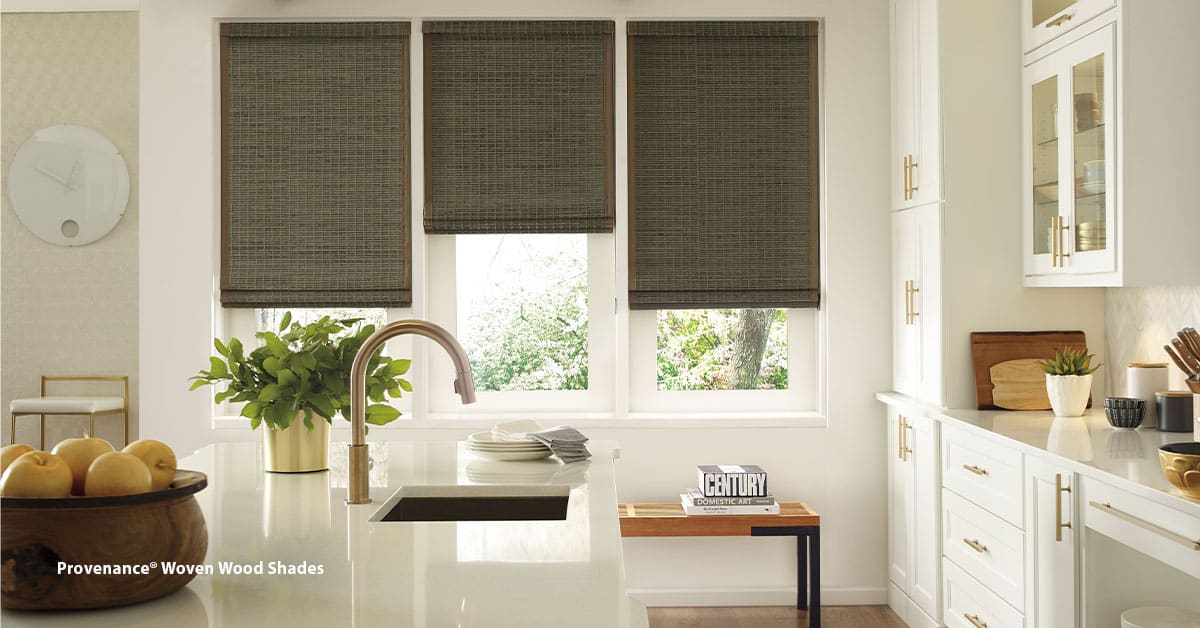
Shades are made from a single piece of fabric or material that raises and lowers as a unit. Roller shades, cellular shades, Roman shades, and woven wood shades all fall into this category. They offer a softer look and come in a wide variety of materials, from sheer curtains to full blackout options. Shades or blinds each have clear use cases, and many homeowners use both across different rooms.
What Are Cellular Shades?
Cellular shades, also called honeycomb shades, are fabric window shades with a structure of small air pockets or cells. Those cells trap air between the glass and the room, which makes them an effective insulating option for both warm and cool climates.
Cellular shades come in single-cell, double-cell, and triple-cell versions. More cells mean more insulation. They’re available in light-filtering and blackout versions, come in a variety of colors and fabrics, and are easy to operate in both cordless and motorized configurations. They’re one of the more versatile window treatments available for homeowners who want to balance looks, light, and energy efficiency.
What About Valances and Curtains?
Yes, they still serve a real purpose beyond decoration.
A valance is a short fabric treatment installed along the top of a window. It can be used on its own or paired with blinds, shades, or drapery to give the window a more finished look. Valances can also hide hardware like rods, headrails, or lift cords. They’re a good option when you want to add privacy and a soft design element without adding a lot of material to the window itself.
Curtains and drapery remain among the most popular covering choices, especially in living rooms and bedrooms. They add privacy, help with insulation, and soften a room’s appearance. Like all window fashions, they can be made to your specific measurements and design style.
What 30 Years of Service Has Taught Us
Most hesitation around window treatments comes down to three things: budget uncertainty, fear of picking the wrong style, and not knowing what the process looks like.
All three go away quickly when you talk to someone with no agenda beyond helping you get it right.
Many window treatment decisions start with a single question that leads to a real conversation. We’ve worked with homeowners across Louisville and Southern Indiana who had one window and homeowners who had an entire new build to furnish. We’ve measured rooms with irregular shapes, old settled walls, and frames that have never had a proper covering. We’ve helped people choose between faux wood blinds and plantation shutters, between cordless and motorized blinds and shades, and between blackout curtains and light-filtering cellular shades.
None of those conversations were simple. None of the questions that started them were embarrassing. The design consultation is built specifically to address what you’re wondering about before you’re committed to anything. That’s why it’s free, and that’s why we take it seriously.
A Simple 3-Step Process for Getting Window Treatments Right
Here’s what to expect from start to finish.
- Free Design Consultation: A designer visits your home, assesses your windows and window frames, listens to your goals, and helps you choose window treatments based on your specific rooms, budget, and priorities. No pressure, no obligation. This is where your common questions get answered in person.
- Custom Design and Manufacturing: Once you approve the design, your new blinds, shades, shutters, or drapery are made to your exact measurements. Most products are manufactured in the USA, and lead times vary by product.
- Professional Installation: Our installation team handles everything and makes sure each covering operates correctly before leaving. Professional installation ensures a precise fit, proper operation, and long-lasting results. It protects the investment you’ve made in your home.
That’s the full process. No surprises, no runaround.
The Honest Bottom Line for Louisville Homeowners
The best decision starts with a real conversation, not a product catalog. If you’ve been putting off a call because you’re not sure what to ask or what things cost, that’s exactly the right time to reach out.
WindowDecor has been serving Louisville, KY and surrounding communities since 1993. We’re a family-owned business and we’ve built that business on referrals and repeat customers, not on pressuring anyone into a sale they weren’t ready for.
Whether you’re thinking about blinds, shades, shutters, or drapery for one room or the whole house, whether your budget is firm or you’re just starting to explore, we’re here to give you straight answers.
Quick Answers
What are the most frequently asked questions about window treatments?
The most common window covering questions we hear are about cost, whether you have to do the whole house at once, and what happens if the first design doesn’t work out. This post covers all three honestly, along with many more. These answers to common questions about window treatments are meant to help you feel confident before your first consultation, with no pressure to buy.
What are the best options for bedrooms and bathrooms?
Bedrooms benefit from blackout or room-darkening options like blackout cellular shades, room-darkening roller shades, or blackout curtains. Faux wood blinds and poly plantation shutters are ideal for bathrooms because they’re moisture-resistant and easy to clean. Bedrooms and bathrooms typically require more privacy than other rooms, so it’s worth prioritizing the right coverings there.
What is the difference between blinds and shades?
Blinds have adjustable slats you can tilt to control light and maintain privacy. Shades are made from a continuous piece of material that raises and lowers as a single unit. Both are popular covering choices. Choosing between shades or blinds depends on the room, your décor, and how you want to manage light day to day.
Do custom window treatments cost more than store-bought options?
Custom blinds and shades typically cost more upfront. However, they’re built to fit your exact frames, use higher-quality materials, and last significantly longer than off-the-shelf alternatives. Most homeowners find the investment worthwhile because of the difference in fit, durability, and design options.
Are motorized window treatments worth it?
For windows that are hard to reach, households with young children, or homeowners who want smart home integration, motorization adds real daily value. Cordless or motorized options eliminate exposed cords, which is one of the top child safety recommendations in the covering industry.
Schedule Your Free Consultation
You don’t need to have everything figured out before you call. Bring your questions, your budget concerns, your awkward window measurements, and everything else on your mind.
Visit windowdecor.com to learn more about our products and services, see our plantation shutters, explore our blinds and shades, or find out what your neighbors in Louisville are saying about working with us.
Call us at (502) 713-3535 or stop by our showroom at 249 America Place, Jeffersonville, IN 47130, by appointment. We offer free in-home consultations with no obligation to buy.
Key Takeaways
- You don’t have to cover every window at once; starting with your most-used rooms is a smart, budget-friendly approach.
- Sharing your budget early helps your designer choose the best window treatments for your home at a price that actually works.
- Custom blinds, shades, and shutters are measured and built for your specific window frames, so unusual shapes and out-of-square windows are handled routinely.
- No design is approved or manufactured without your sign-off, so there’s no risk of ending up with something you didn’t choose.
- Bedrooms and bathrooms typically require more privacy and moisture resistance; faux wood blinds and blackout cellular shades are common solutions in those rooms.
- Cellular shades are one of the most energy-efficient window treatments available because of their insulating air pocket structure.
- Motorized and cordless blinds and shades add safety and convenience, especially for homes with young children or hard-to-reach windows.
- Curtains, drapery, and valances still play a valuable role in living rooms and bedrooms, adding privacy, insulation, and a finished look.
- A free in-home consultation is a no-obligation conversation where your common questions get honest, room-specific answers.
